What hardware for a local AI server
Building an AI server in-house looks like a conventional IT exercise. It is not. The criteria that make a good inference machine are not those of an application server, and sizing mistakes are paid for immediately.
Memory first, compute second
On a conventional server you look at the processor. On an inference machine you look first at the memory accessible to the graphics processor, because it determines which models can run at all. Compute then determines how fast the answers come.
The order matters. A very powerful machine with little memory cannot run a large model, however powerful it is. A more modest machine with plenty of memory runs it, more slowly, but it runs it.
Dedicated memory or unified memory
The classic architecture separates processor memory from graphics card memory. Every exchange between the two crosses a bus, which costs time. To go beyond a certain model size you then have to stack several cards, with the cost, power draw and complexity that follow.
Unified architecture removes that separation: processor and graphics side address the same memory space. The NVIDIA GB10 Grace Blackwell superchip follows this principle with 128 GB unified, which loads models in a desktop enclosure that previously required a multi-card configuration.
The line items everyone forgets
The budget for an in-house AI server almost always exceeds the initial estimate, because several line items go unanticipated.
- Power supply: a multi-GPU configuration frequently exceeds what a standard office socket can deliver.
- Cooling and noise: these machines are designed for technical rooms, not for an open-plan floor.
- Fast storage: models weigh tens of gigabytes and are loaded often. Slow storage penalises every start.
- The software layer: drivers, inference engine, model updates. This is the line item that consumes the most internal time over the years.
Sizing by number of users
Inference occupies the machine for as long as it takes to produce an answer. But usage is intermittent: you ask, you read, you work, you come back. Sizing is therefore based on real concurrency, not on the number of accounts.
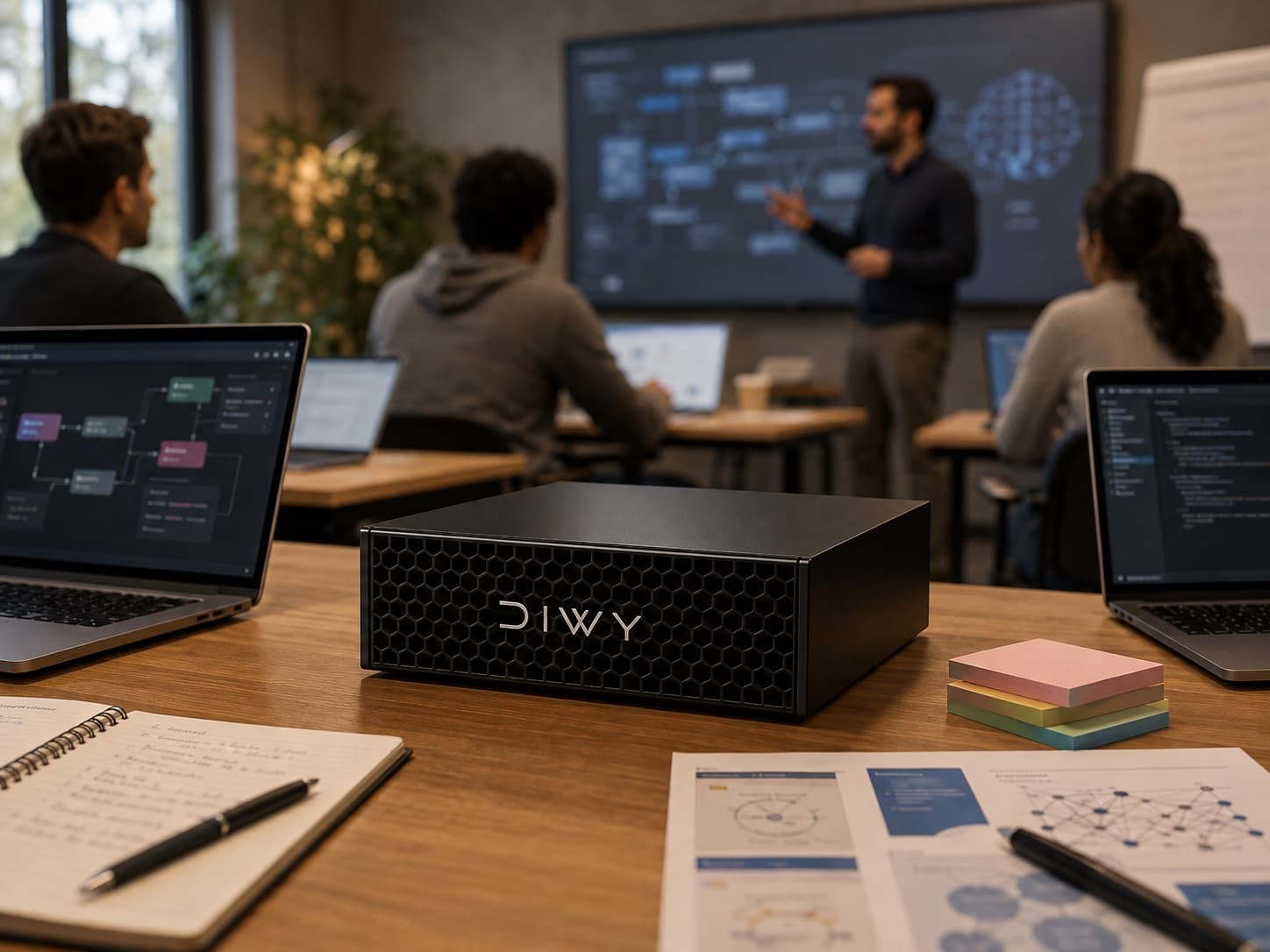
For a team of twenty to thirty people, a single well-sized machine is usually enough. DIWY is calibrated for around twenty concurrent users on everyday work, with 1 PFLOP at FP4 precision, 128 GB of unified memory and 2 to 4 TB of encrypted storage.
Buy, build or rent
Building it yourself gives the best control and the worst ratio of time invested to result, unless you already have MLOps skills in-house. Hardware is only the visible part: it is the software layer that demands continuous attention.
Buying a ready-made machine removes the assembly but leaves operations and obsolescence on your side, in a field where hardware moves fast.
Renting shifts that risk to the vendor. DIWY is offered at 500 € per month with a 24-month commitment, or 750 € per month with no commitment, with a hardware guarantee paid at checkout (750 € on the commitment, 1,500 € without) and returned at the end of the contract. Hardware, Devana OS, Suite 366 and Devana are included, and the box is delivered within 72 hours.
Key points
- Accessible memory determines which models run. Compute only sets the speed.
- Unified memory avoids stacking graphics cards to reach the model size you want.
- Power, noise, fast storage and software maintenance are the systematically underestimated line items.
- Sizing is calculated on real concurrency, not on the number of declared users.
Frequently asked questions
Is a gaming graphics card enough?
For exploring, yes. For shared use, available memory quickly becomes limiting, and nothing is designed for continuous operation or several concurrent users.
Do you need a server room?
Not with a desktop machine. DIWY plugs into a standard socket and into your network, with no air conditioning and no dedicated rack.
How much storage should you plan for?
Plan generously. Between several models, their quantised variants and the index of your documents, space goes fast. DIWY ships with 2 to 4 TB of encrypted storage.
Will the hardware be obsolete in two years?
The field moves fast, that is a fact. It is the main argument for renting rather than buying: the obsolescence risk stays with the vendor.
Your AI, inside your walls.
DIWY is available now, delivered within 72 hours, preconfigured with your applications.
Order a DIWY*